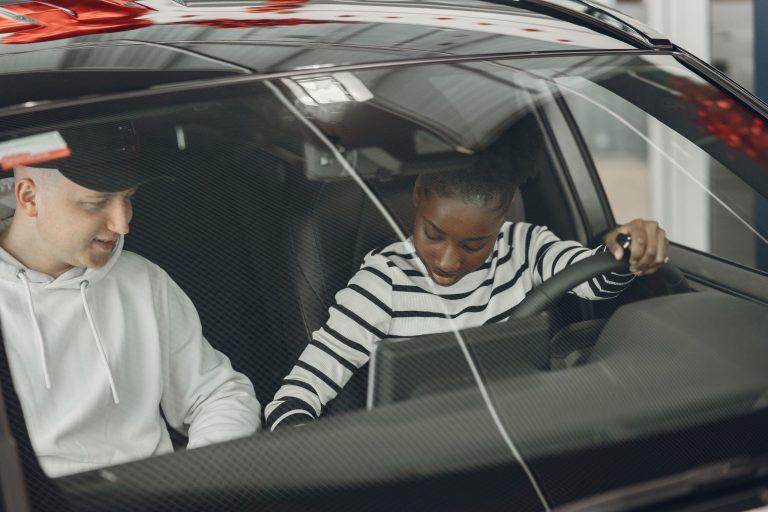


Ask a learner how they know they are ready for the driving test and you will usually get a version of the same answer: “I feel ready.” Ask their supervising parent and you will get “she drives fine, I don’t worry anymore.”
Neither of those is evidence. Both are feelings, and feelings are a poor predictor of outcomes at a testing centre where roughly half of candidates do not pass on a given attempt.
A mock test replaces the feeling with information.
What a Mock Test Actually Is
A properly run mock test is a simulated driving test conducted under conditions as close to the real thing as practical. It starts from the testing centre itself, follows genuine local routes, and includes the same set manoeuvres. The instructor gives directions the way a testing officer does, marks against the same criteria, and — critically — does not coach during the drive.
That last point is what separates a mock test from an ordinary lesson. In a lesson, the instructor is talking you through things, prompting, correcting in real time. In a mock test, they are silent except for directions. You discover what you actually do when nobody is reminding you.
Almost every learner is surprised by that difference. Skills that seem solid in a lesson turn out to have been partly propped up by prompts.
What It Reveals
The faults you cannot see
Every driver has habits invisible to themselves. A head check that is a fraction too quick. A rolling stop at a quiet stop sign. A tendency to sit slightly too close in traffic. A left indicator that never gets cancelled after a roundabout.
Supervising parents rarely catch these, because they either do the same things themselves or stopped noticing years ago. A mock test surfaces them in a form you can act on: a written list, ranked by severity.
How you perform without prompts
The distinction between “can do it” and “does do it, unprompted, under mild pressure” is the whole difference between passing and failing.
How you handle a mistake
Perhaps the most valuable output. You will make an error during a mock test, and the instructor gets to observe what happens in the sixty seconds afterwards. Do you reset and drive on, or does your performance degrade?
A great many tests are lost not to the first fault but to the cascade that follows it. That pattern is entirely fixable once identified, but you cannot identify it in a lesson where the instructor immediately reassures you.
Whether you are actually ready
Sometimes the answer is no, and that is genuinely useful. A test booking costs money and, if unsuccessful, imposes a mandatory waiting period before you can try again. Discovering six weeks out that you need more work on gap selection is much better than discovering it on the day.
Sometimes the answer is yes, and that is useful too. Confidence grounded in a completed simulated run is far steadier than confidence based on a vague sense that things have been going well.
The Anxiety Argument
There is a separate case for mock tests that has nothing to do with skill.
Most test-day anxiety is fear of the unknown — an unfamiliar building, an unfamiliar procedure, an unfamiliar person marking a sheet you have never seen. A mock test converts almost all of that into a known quantity.
The second time you do something is always less frightening than the first. A mock test makes the real test the second time.
Learners who have done one report that the actual assessment felt oddly routine, which is exactly the state you want to be in.
When to Do It
The timing matters more than most people realise.
Too early and the feedback is just a list of things you already knew you had not learned yet.
Too late — a few days before the test — and you have no time to act on what you find. Discovering a significant weakness 48 hours out mostly generates anxiety.
The sweet spot is roughly four to six weeks before your booked test. Long enough to work on two or three specific faults, short enough that you are near your final standard.
Some learners do two: one at around six weeks to generate the work list, and one about a week out to confirm the fixes have held.
What Makes a Mock Test Worth Doing
Not all of them are equal. The ones that provide real value share several features.
It starts from the testing centre. Starting cold from the same place, in the same conditions, is part of the point.
It uses genuine local routes. Around Macquarie Fields, that means the roundabout-heavy roads through the surrounding suburbs, not a generic circuit.
The instructor stays quiet. Directions only. No coaching.
It is marked against the real criteria. You should come away with something resembling an actual score sheet, not a general impression.
There is a proper debrief. The drive itself is only half the value. The conversation afterwards — what happened, why it happened, and specifically what to practise — is the other half.
It runs at the same time of day as your booking. A 3pm mock test for a 3pm booking accounts for school zones, traffic and light conditions that an 11am session would miss entirely.
Using the Results
A mock test is worthless if the feedback goes in a drawer. The learners who benefit most do something specific with it.
Take the two or three most serious faults and build practice sessions around each. If gap selection at T-junctions was the problem, spend a session doing nothing but T-junctions, twenty repetitions with feedback on each. If it was roundabout lane discipline, drill one roundabout from every approach.
Resist the temptation to spread effort evenly across everything. Two faults fixed properly is worth more than eight faults slightly improved.
The Honest Caveat
A mock test does not guarantee a pass. Traffic on the day is different, the route may be one you did not rehearse, and nerves are real.
What it does is remove the largest controllable sources of failure: unknown weaknesses, unfamiliarity with the process, and untested assumptions about readiness. That is a meaningful shift in the odds, particularly at a centre where the margin between passing and not is often two or three avoidable faults.
Find Out Where You Actually Stand
Road Users Driving School runs one-hour Mock Test Sessions starting directly from the Macquarie Fields testing centre, on genuine local routes, under realistic conditions. You finish with a clear picture of what an officer would mark and exactly what to work on before the real thing.
Book a mock test online or call 0411 309 031. Pick-up available across Macquarie Fields, Glenfield and Ingleburn.