

There is a particular frustration reserved for experienced drivers who fail a NSW driving test. You have driven for fifteen years. You have driven in cities far more chaotic than Ingleburn. And a testing officer has just handed you a score sheet full of faults for things you have done safely, without incident, for a decade and a half.
It happens constantly in south west Sydney, which has one of the highest concentrations of overseas licence holders in the country. And it happens for a reason that has nothing to do with driving ability.
The Real Problem: You Are Being Assessed on Method, Not Outcome
An experienced driver arrives at a roundabout, reads the situation instantly, and proceeds safely. The testing officer marks them down for inadequate observation.
Both are correct. The driver did observe — through years of accumulated peripheral awareness that requires almost no visible head movement. The officer cannot assess what they cannot see. The NSW driving test assesses whether you perform a defined set of observable actions in a defined order.
This is the single insight that changes everything for overseas licence holders. You are not being asked to prove you can drive. You are being asked to demonstrate a specific method, visibly, for the duration of the assessment.
That reframing usually turns a frustrated candidate into a successful one within a handful of lessons.
Where You Stand Before You Start
What is required to convert a licence in New South Wales depends on which country issued it. Holders of licences from certain recognised countries may be able to convert without a practical test. Everyone else generally needs to pass the knowledge test and then the practical driving test, though the requirement to accumulate 120 logbook hours does not apply in the same way to adults converting an existing overseas licence.
Because the rules vary by country, by age and by licence class, and because they change, check your specific situation directly with Service NSW rather than relying on what a friend or relative went through. A conversation at the counter or on the phone takes ten minutes and prevents a great deal of wasted effort.
What is universal is this: if you do have to sit a practical test, you will be assessed against exactly the same criteria as a seventeen-year-old learner, with no allowance for experience.
The Habits That Cost Experienced Drivers Marks
Invisible observation
The big one. Experienced drivers check mirrors with eye movement alone and judge blind spots from accumulated awareness. On a test, you need a deliberate, visible head turn at every lane change, every merge, every pull-out from the kerb, and before every reversing manoeuvre.
It will feel theatrical and unnecessary. Do it anyway.
Hand position and steering
Long-time drivers develop relaxed one-handed steering, palming the wheel through turns, or resting a hand on the gear selector. None of that is assessed favourably. Keep both hands on the wheel except when genuinely operating a control, and steer with a controlled hand-over-hand or pull-push technique.
Rolling stops
At a stop sign, the vehicle must come to a complete stop — wheels stationary. A slow roll after a good look is a fail, not a fault. This is one of the most common single reasons experienced drivers lose their test, because a rolling stop is the habit of anyone who has driven for years without incident.
Speed at the limit rather than under it
Confident drivers sit at, or a whisker above, the posted limit. On a test, aim a few kilometres per hour below. Speedometers have tolerances and testing officers do not.
Equally, driving significantly under the limit without reason is also marked. On a 60 road with clear conditions, doing 45 is assessed as impeding traffic.
Assumed right of way
In many countries, negotiation and assertion are how intersections work. In NSW, give-way rules are formal and expected to be followed exactly. Testing officers will mark any instance where you proceed without a clear entitlement, even if the other driver waved you through.
The Local Complication: This Area’s Roads
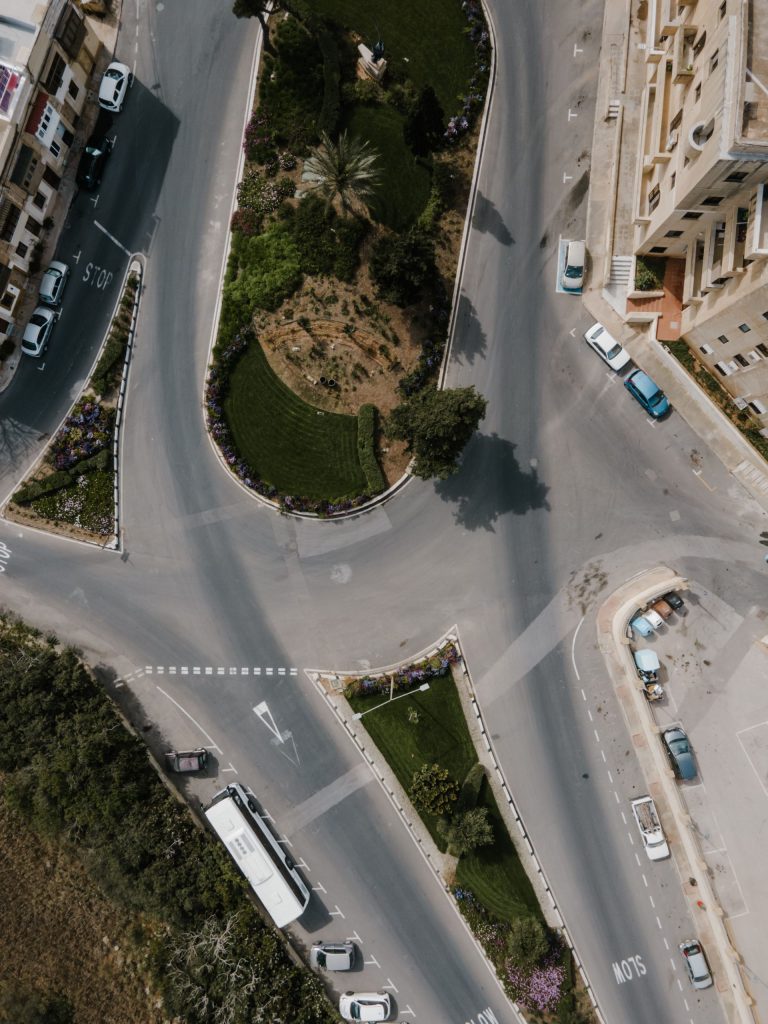
Overseas licence holders converting in south west Sydney face an additional layer of difficulty, because the Macquarie Fields test area is roundabout-heavy.
Roundabout conventions differ substantially between countries. Lane selection rules, signalling requirements and give-way priorities that are correct elsewhere may be marked as faults here. A driver who learned in a country where you signal on exit only, or where lane discipline inside a roundabout is loose, will accumulate faults quickly without ever feeling that they did anything wrong.
The NSW conventions worth committing to memory:
- Give way to all traffic already in the roundabout.
- Signal right on approach if turning right, left if turning left, nothing if going straight.
- Always signal left before exiting, where practicable.
- Stay strictly in your lane the entire way around.
- Lane selection is determined by your exit and by the road markings, which override the general rule.
Rules That Frequently Surprise Newcomers
Keep left unless overtaking applies on multi-lane roads where the speed limit is above 80 km/h, and wherever a “keep left unless overtaking” sign is displayed.
Mobile phones. Full licence holders may use a phone in a properly mounted cradle for limited functions. Learner and provisional drivers may not use a phone at all — not hands-free, not mounted, not on speaker.
Alcohol. Zero blood alcohol for learner and provisional drivers. Full licence holders are limited to under 0.05.
School zones. 40 km/h during posted hours on school days, with substantially higher penalties than equivalent offences elsewhere.
Emergency vehicles. You must slow to 40 km/h when passing a stationary emergency vehicle displaying flashing lights.
Roads are patrolled by camera extensively. Fixed cameras, mobile cameras and average-speed enforcement for heavy vehicles are widespread.
How Many Lessons Do You Actually Need?
Far fewer than a beginner, but rarely zero.
Most experienced overseas licence holders need somewhere between two and six hours with a local instructor. The purpose is not to teach driving. It is to identify the specific habits that will be marked, drill the NSW-specific conventions, and rehearse on the actual roads the test uses.
A four-hour block is a common structure — enough to cover the score sheet criteria, work the local roundabouts and merges, and finish with a realistic simulated run.
The learners who skip this step and go straight to a test on the strength of their experience are, in this area, the ones most likely to be sitting the test a second time.
The Mindset That Works
Treat the test as an exam in a subject you already know rather than a judgement on your competence. You are learning the syllabus and the marking scheme for a system you have not been assessed under before.
Nobody is questioning whether you can drive. They are checking whether you can drive the way NSW assesses driving, on a specific morning, on specific roads. Those are different things, and only one of them is on the score sheet.
A Structured Path to Conversion
Road Users Driving School works regularly with experienced drivers converting overseas licences in south west Sydney. Our Test Booster package is built for exactly this situation — four hours covering the local test routes, a breakdown of how testing officers mark the score sheet, and focused work on dual-lane roundabouts, complex intersections and parking to NSW standards.
Book online or call 0411 309 031. Male and female instructors available, with pick-up across Macquarie Fields, Glenfield and Ingleburn.