

If you have booked a driving test at the Macquarie Fields Driver Testing Centre, someone has probably already told you that it is a “hard” centre. Sit in the waiting area at Building H on the ground floor of the Macquarie Fields TAFE campus at 32 Victoria Road for twenty minutes and you will hear the same conversation on repeat: this one is tricky, my cousin failed here twice, you should have booked somewhere else.
The numbers do show that roughly half of the drivers who present here on any given week walk out without a licence. That figure gets quoted constantly, usually as a warning. We think it is far more useful as a diagnosis. A pass rate is not a measure of luck. It is a measure of how well the local road environment matches the skills that learners typically arrive with — and once you understand exactly where that mismatch sits, the number stops being intimidating and starts being a study guide.
A Pass Rate Is a Description of the Roads, Not a Curse
Every testing centre in New South Wales runs its assessments on a set of routes that radiate out from the centre itself. Testing officers are not choosing scenery. They are choosing roads that will reliably produce the situations they are required to assess: gap selection, speed management, observation, lane discipline, and decision-making under mild pressure.
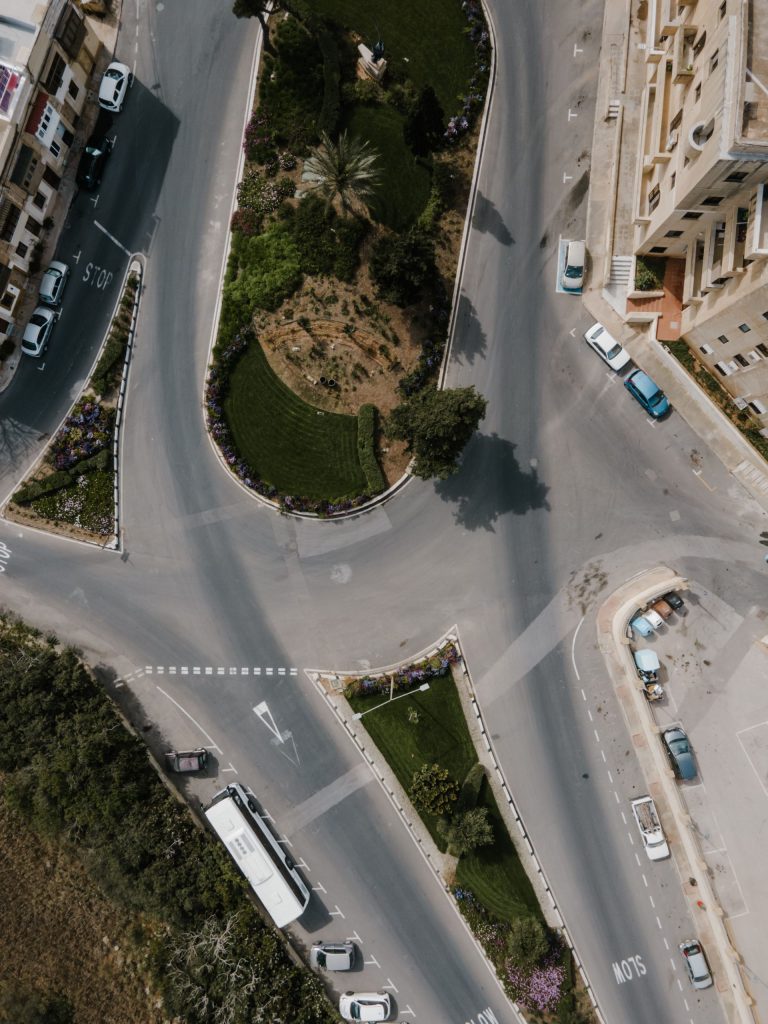
The area around Macquarie Fields, Ingleburn and Glenfield happens to be unusually rich in one particular feature — roundabouts. A single test route in this area can include more than a dozen of them, many of them dual-lane, while including only a handful of sets of traffic lights. Compare that to a testing centre in an older inner-suburban grid, where a candidate might meet fifteen sets of signals and two roundabouts across the same distance.
That single structural fact explains most of the difference in outcomes. It is not that learners in south west Sydney are worse drivers. It is that a Macquarie Fields test concentrates an enormous number of repetitions of the one manoeuvre that supervised private practice tends to under-train.
Why Roundabouts Punish Casual Practice
A set of traffic lights makes the decision for you. Green means go, red means stop, and the only judgement required is whether to proceed on amber. A roundabout hands the entire decision back to the driver. You must simultaneously read approaching traffic from the right, choose the correct entry lane based on where you intend to exit, signal at the right moment, adjust your speed so you arrive at the give-way line at a speed that lets you either flow through or stop cleanly, and then maintain your lane discipline all the way around.
On a single-lane roundabout, sloppy technique is often invisible. On a dual-lane roundabout, every one of those errors becomes a marked fault. Drifting wide out of your lane on the exit, failing to signal left before leaving, entering from the left lane when you intend to go right around — these are the faults that accumulate quietly across a route until the candidate is over the limit without ever having done anything dramatic.
Most private supervised practice happens on trips with a purpose: the shops, school pick-up, a relative’s house in Minto. Those trips build familiarity with a handful of routes. They do not build the deliberate, repeated exposure to varied roundabout geometry that a Macquarie Fields test demands.
The Faults That Actually End Tests Around Here
Across the local area, a fairly consistent pattern shows up in the way tests end early or fall short.
Testing officer intervention at T-junctions. Nothing ends a test faster than the officer touching the wheel or the brake. In this area, that most often happens at unsignalised T-junctions where a learner creeps out looking for a gap, commits, and then discovers the gap was smaller than it looked. Gap selection is a skill of judgement, and judgement only develops through repetition with feedback.
Following distance. On the arterial stretches around Ingleburn and Campbelltown Road, traffic moves at a decent clip and bunches up. Learners who have practised mostly on quiet residential streets have not calibrated a three-second gap at 70 or 80 kilometres per hour. They sit too close, get marked, and then compensate by braking abruptly, which gets marked again.
School zones. The stretch of suburbs from Glenfield through Macquarie Fields to Ingleburn is dense with schools, and the 40 km/h zones are active twice a day on school days. A test booked at 8:45 in the morning or 2:45 in the afternoon will almost certainly pass through at least one active zone. Missing the signage is an immediate and serious fault.
Lane changes in peak traffic. Head checks that are too quick to be genuine, or lane changes made without leaving enough space, are extremely common. Officers are looking for a deliberate, unhurried head movement, not a token glance.
What This Means for How You Prepare
The practical conclusion is straightforward. If half of the candidates at a centre are failing for a fairly narrow set of reasons, and those reasons are known, then targeted preparation moves your odds enormously.
Preparation that works in this area looks like this:
Deliberate roundabout drilling. Not “we went around a few roundabouts on the way to Bunnings,” but a session designed around them — approaching the same dual-lane roundabout from different directions, taking different exits, and rehearsing the lane choice out loud until it becomes automatic.
Practice at the time of day your test is booked. The roads around Victoria Road at 3pm on a Tuesday bear very little resemblance to the same roads at 11am. If your test is at 3pm, that is when you should be practising.
Learning how the score sheet works. Many learners have never seen the criteria they are being assessed against. Knowing the difference between a fault that is noted and a fault that ends the assessment changes how you drive. It also changes how you recover from a small mistake, which matters more than most people realise — a great many tests are lost not to the first error but to the panic that follows it.
At least one full simulated run. A mock test conducted on genuine local roads, under realistic conditions, with a debrief afterwards, is the single most efficient diagnostic available. It converts a vague sense of “I think I’m ready” into a specific list of two or three things to fix.
Booking Somewhere Else Is Usually the Wrong Answer
Learners occasionally decide to book a test at a centre with a friendlier reputation. Sometimes that is a sensible logistical choice. Often it is not, for two reasons.
First, you will be driving in south west Sydney for the rest of your life. The roundabouts on Eagleview Road and the merges around Ingleburn do not disappear once you have a licence — they simply stop being assessed. A licence obtained by avoiding the roads you actually drive on is a licence that leaves you underprepared on your first solo trip.
Second, an unfamiliar centre means unfamiliar roads. You trade a known difficulty for an unknown one, and you add travel time and stress to a morning that already has enough of both.
Reframing the Number
A pass rate near fifty per cent means that a coin-flip amount of candidates arrive underprepared for the specific demands of this specific area. It does not mean the officers are harsh, and it does not mean the test is unfair. Every candidate is assessed against the same national criteria.
What it means is that generic preparation produces generic results, and that local preparation is worth a very great deal here. Learners who have spent time on the actual roads, at the actual times, working through the actual manoeuvres that this area throws at them, do not experience a fifty per cent pass rate. They experience something considerably better.
The test is not the enemy. Turning up having practised the wrong things is.
Get Local Preparation Before Your Test
Road Users Driving School is based in Macquarie Fields, minutes from the testing centre itself. Our instructors know the local routes, the roundabouts and the timing traps, and every lesson is built around what you personally need to fix rather than a fixed syllabus. If your test is coming up, a Mock Test Session on real local roads will tell you exactly where you stand.
Book a session online or call us on 0411 309 031. We pick up and drop off across Macquarie Fields, Glenfield and Ingleburn.